On August 12, we celebrated International Youth Day, a day that recognizes the important role young people play in shaping our communities and our future. Young people are more than the leaders of tomorrow. They are students, researchers, innovators, workers, volunteers, and community members today. The opportunities we create for them today can shape not only their individual futures, but also the future of our communities.
The world young people are entering is changing rapidly. Declining birth rates, changing patterns in college enrollment, challenges in educational persistence, evolving workforce expectations, and the rapid development of artificial intelligence (AI) and generative AI are transforming how we learn, work, and participate in society. These changes require us to rethink how we prepare and support the next generation.
Preparing young people for the future requires more than encouraging them to pursue a degree or find a job. It means creating opportunities for them to explore their interests, develop practical skills, understand real-world challenges, connect with mentors, participate in their communities, and discover pathways toward meaningful careers.
At Source of Life Ministry International, Inc. (SOLFMIT), we believe in building opportunities for all to live with dignity. For young people, that means creating pathways to education, research, mentorship, leadership, community engagement, and workforce opportunities. Our youth initiatives are designed to support young people at different stages of their educational and professional journeys.
Building Pathways Through Education and Career Support
One of the most important ways we can support young people is by investing in their long-term educational and professional goals.
Through our youth development initiatives, SOLFMIT provides support through educational fellowships, career coaching, mentorship, and professional development opportunities. Our goal is to encourage young people to pursue their aspirations while providing support along the way. This year, we are proud to support two fellows whose educational journeys reflect different pathways toward professional and community leadership.
Ms. Leyina Pierre is pursuing Architectural Engineering at Universidad del Desarrollo (UDD) in Chile. An aspiring engineer, Leyina has been supported through our fellowship initiative since 2025. Her journey demonstrates the importance of sustained support as young people pursue specialized education and build their professional futures.
Ms. Priya Boyce is pursuing a Bachelor of Arts degree in Political Science and Psychology, with a concentration in Public Policy, at Grinnell College. An aspiring lawyer, Priya is developing an interdisciplinary foundation that connects people, policy, and systems.
Their paths are different, but the principle is the same: “when young people have access to opportunity and support, they are better positioned to turn their aspirations into reality”.
Our goal is to continue creating pathways that help young people move from aspiration to action.
Building Pathways Through Research and Mentorship
Education becomes even more meaningful when young people have opportunities to apply what they learn beyond the classroom. Through our youth research and mentorship activities, students from middle school, high school, and undergraduate programs gain hands-on experience in community research, population health, and social research. They learn to ask meaningful questions, work with data, examine health and social challenges, and think critically about possible solutions.
These experiences help students develop skills in research methodology, data analysis, communication, critical thinking, and problem-solving, while introducing them to potential careers in public health, social work, healthcare, policy, research, and healthcare analytics.
Our interns are also gaining experience through different roles within this work. Ms. Sophia Lin and Ms. Arfah Mughal are contributing to population health research and developing experience in analytical work, gaining practical exposure to how data and research can be used to better understand health and social issues affecting communities. Our middle school volunteers aid them in this process.
At the same time, Mr. Nuriddin Fazliddinov, Ms. Kaitlyn Jamet, and Ms. Armeet Kaur served as near-peer mentors in community research this summer, supporting younger students as they learned about research and explored real-world health and social challenges. This creates an opportunity for young people at different stages of their education to learn from one another while developing their own skills and leadership experience.
Community-based research also helps students connect what they learn in the classroom with the communities and real-world issues around them. A student may understand a subject well and perform exceptionally in a classroom, yet applying that knowledge to a real-world problem often requires a different kind of thinking—the ability to recognize connections between subjects, bring together different areas of knowledge, and understand how they interact in practice.
For example, understanding a community health issue may require students to draw on biology, statistics, social science, economics, communication, and policy rather than viewing each subject in isolation. Research experiences give students an opportunity to see how these different areas of knowledge can come together to understand a problem and explore possible solutions.
When students have the opportunity not only to learn about a problem but also to investigate it and contribute to finding solutions, they begin to see themselves not simply as students, but as researchers, contributors, and future leaders.
Through this model, we hope to create a pathway where young people can move from learning, to applying, to researching, and ultimately to mentoring others—building knowledge, confidence, and leadership along the way.
Preparing Young People for an AI-Driven World
The world of work is changing, and youth development must change with it. At SOLFMIT, we believe that building pathways to opportunity also means being willing to adapt how we prepare young people for the future.
Generative AI is becoming an increasingly important part of how research is conducted, information is analyzed, and work gets done. Rather than treating these changes as something young people will encounter later in their careers, we believe they should have opportunities to learn how to navigate them now.
In alignment with this approach, our interns are already incorporating AI tools into their work. Our interns are using AI tools as part of their research and analytical activities, gaining practical experience with how emerging technologies can support research, organize information, explore ideas, and improve efficiency.
At the same time, we recognize that using AI effectively requires more than knowing which tool to use. It requires the ability to ask the right questions, evaluate the information produced, verify sources, recognize limitations, and apply human judgment. These skills become increasingly important as AI becomes more accessible and integrated into education and the workplace.
Our approach is not to separate technology from youth development, but to help young people learn how to adapt responsibly as technology evolves. By incorporating AI into real research and learning experiences, we are creating opportunities for young people to develop both technological awareness and the critical thinking needed to participate confidently in a changing world of work.
Building Pathways Through Partnership
Building opportunities for young people requires collaboration across educational institutions, community organizations, and other partners. At SOLFMIT, we have been developing relationships with academic institutions to create opportunities that connect education, research, mentorship, and career development.
Our collaboration this year with Hofstra University’s Hofstra University Summer Science Research Program (HUSSRP) has provided an opportunity for high school students interested in science and research to extend their learning beyond the traditional classroom. Programs such as HUSSRP demonstrate the value of experiential education—giving students opportunities to engage in real research, connect with communities, explore real-world issues, and apply what they learn to problems beyond the classroom. Through our collaboration, participating students had an opportunity to engage with community members for community-based research focused on real-world health and social issues, while also receiving near-peer mentorship from interns with prior research experience.
Experiences like these can help young people see that education is not limited to what happens in a classroom or laboratory. It can also involve asking meaningful questions, working with communities, analyzing information, understanding problems, and thinking about possible solutions. We are grateful to Hofstra University and the HUSSRP team for the opportunity to contribute to this meaningful learning experience.
Building Pathways Through Volunteering and Community Leadership
Youth development is also about creating opportunities for young people to serve, lead, and make a difference in their communities. Many young people participate in SOLFMIT activities through volunteering, community events, outreach, and tabling activities. These experiences give youth an opportunity to interact with community members, learn about the needs of others, develop communication and leadership skills, and see firsthand how small acts of service can contribute to a larger community effort. We have seen how these experiences can inspire young people to take what they learn and create opportunities of their own.
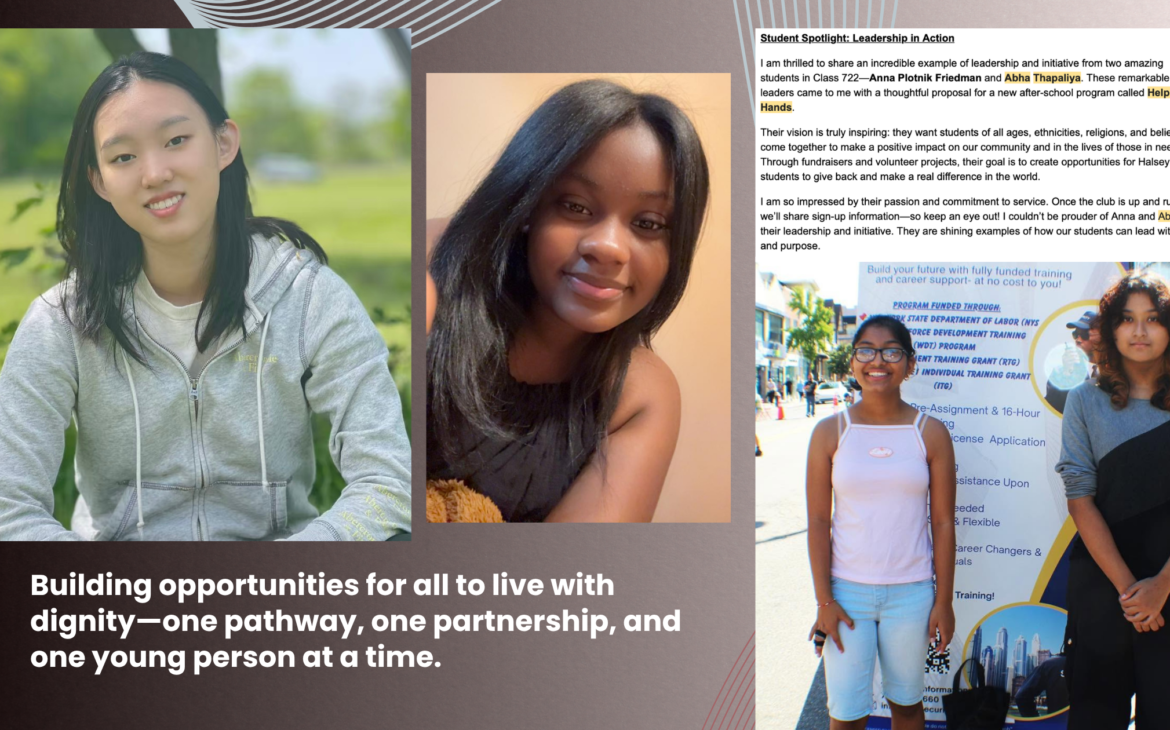
Our youngest volunteer, Abha Thapaliya, was inspired by her experience with community service and brought that idea back to her school. She became a co-founder of “Helping Hands,” a student-led initiative at her school that brings students of different ages, ethnicities, religions, and beliefs together to create volunteer and fundraising opportunities that make a positive impact on the community and the lives of those in need. Through fundraisers and volunteer projects, Helping Hands aims to create opportunities for students at J.H.S 159 Stephen Halsey to give back and make a meaningful difference in the world. Abha’s experience is an example of what youth development can look like at its best. A young person participated in a community activity, saw an opportunity to help, and then carried that idea into her own school community.
“When we give young people opportunities to serve, we also give them opportunities to lead”.
Connecting Pathways to Workforce Opportunities
Preparing young people for the future also means recognizing that there is no single pathway to a successful career. College and professional degrees are important pathways, but vocational education, certifications, and workforce training can also provide valuable opportunities to develop practical skills and enter the workforce while continuing to pursue longer-term educational goals.
SOLFMIT works to connect young people with vocational training, workforce opportunities, and professional education pathways that can complement their educational and career aspirations. Through our partnership with LASI Security Company, Inc., a small business providing security services and workforce training opportunities, we help connect individuals with practical security guard training and pathways into the workforce. These opportunities can provide young people with valuable skills and work experience while they pursue their longer-term educational and professional goals.
We have also worked to connect individuals interested in healthcare careers with training opportunities through Lehman College, including Certified Nursing Assistant (CNA) and pharmacy technician programs. Last year, we referred several candidates to these programs and helped connect them with available educational and financial support opportunities. As we continue to expand our youth initiatives, we plan to develop and bring additional career-focused training opportunities to young people, building on relationships that can connect education, training, and workforce opportunities.
Our vision is to continue creating programs that give young people practical options for entering the workforce while also supporting their longer-term educational and career aspirations.
Investing in the Next Generation
Youth development is not simply about preparing young people for a distant future. It is about creating opportunities for them to learn, explore, contribute, serve, lead, and build meaningful futures today.
At SOLFMIT, we are building youth initiatives around interconnected pathways to education, research, mentorship, partnership, leadership, community engagement, and workforce opportunity. We want young people to have the opportunity to discover their strengths, develop new skills, explore careers, contribute to their communities, and pursue the future they envision for themselves.
The world will continue to change. Technology will continue to evolve. Career pathways will continue to shift. Our responsibility is to make sure that young people have the skills, support, confidence, and opportunities to navigate those changes, shape what comes next, and build stable and meaningful futures for themselves. Because investing in youth is not simply an investment in individual students. It is an investment in stronger communities and a stronger future. At Source of Life Ministry International, we remain committed to our vision of building opportunities for all to live with dignity—one pathway, one partnership, and one young person at a time.
A Note of Appreciation
We are grateful to our academic and community partners who help make these opportunities possible. We especially appreciate Dr. Daniel P. Miller and Dr. Wendy Holmes, Co-Directors of HUSSRP, for their collaboration and commitment to creating meaningful research experiences for high school students.
We also extend our appreciation to Ms. Sally Fairman, Ms. Colleen Pike Blair, and Mr. Romardio Hamilton of Lehman College, CUNY, for their support in connecting individuals with career-focused educational opportunities.
We are also grateful to Mr. Frantz F. Pierre and Mr. Purushotam Thapaliya of LASI Security Company, Inc. for their partnership and support in creating pathways to workforce training and employment opportunities. Their willingness to collaborate with SOLFMIT demonstrates how small businesses can play an important role in connecting young people and community members with practical skills, training, and opportunities to enter the workforce.
These collaborations remind us that meaningful youth development is a shared effort. By working together across educational institutions, community organizations, small businesses, and workforce partners, we can create more opportunities for young people to learn, grow, serve, and build their futures.
A Note About HUSSRP
HUSSRP is a program of Hofstra University; SOLFMIT does not operate or administer the program. Through our collaboration this year, participating students had an opportunity to engage in community-based research focused on real-world health and social issues, while also receiving near-peer mentorship from interns with prior research experience.
We are grateful to Hofstra University and the HUSSRP team for the opportunity to contribute to this meaningful learning experience.
Get Involved
If you are interested in learning more about our fellowship and youth development opportunities, we invite you to complete our interest form. Whether you are a student, parent, educator, mentor, or community member, we welcome the opportunity to connect with you.
Fill Out the Youth Development & Fellowship Interest Form
If you or someone you know is interested in our free security guard training program, please complete the interest form below to learn more about available opportunities.
Fill Out the Free Security Guard Training Interest Form
Support the Next Generation
Every young person deserves the opportunity to learn, grow, discover their potential, and build a future with dignity. Your support helps us turn that belief into opportunities—through fellowships, research experiences, mentorship, community engagement, and pathways to workforce training.
A donation to SOLFMIT is more than a contribution to a program. It is an investment in a young person’s opportunity to see a possibility, take a step forward, and build a future they can believe in.
If you believe in creating those opportunities, we invite you to support our work.
Support Our Youth Initiatives — Donate Today
Source of Life Ministry International, Inc.
Building opportunities for all to live with dignity—one pathway, one partnership, and one young person at a time
“`